Supinador e tabaqueira anatômica: o território do nervo radial profundo
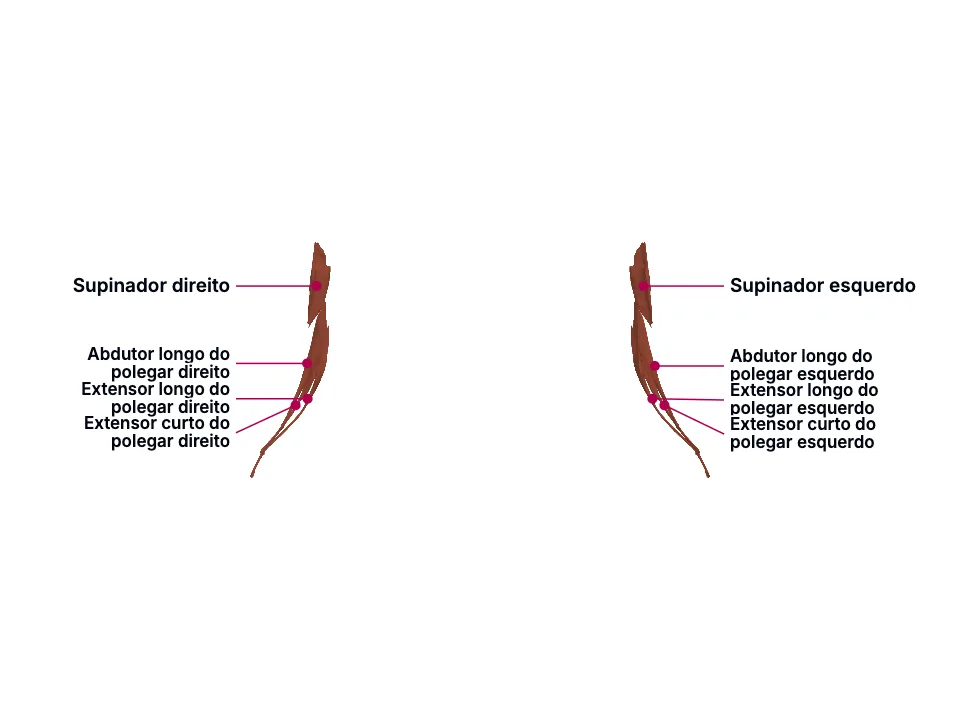
O ramo profundo do nervo radial atravessa o músculo supinador e emerge do lado distal como nervo interósseo posterior (NIP) - numa variante anatômica, ele atravessa a arcada de Frohse, a borda proximal do supinador e o sítio mais comum de compressão desse nervo, base da síndrome do túnel radial (dor sem fraqueza, diagnóstico diferencial de epicondilite lateral) e, quando há lesão axonal, da síndrome de compressão do próprio NIP (fraqueza distal com extensão do punho preservada). O mesmo NIP inerva os três tendões que formam a tabaqueira anatômica: o extensor longo do polegar sozinho na borda ulnar, e o abdutor longo do polegar junto do extensor curto do polegar na borda radial. A dor à palpação da tabaqueira é o achado clássico de suspeita de fratura de escafoide (o osso que forma seu assoalho); o espessamento do túnel que aperta o abdutor longo e o extensor curto do polegar é a base da tenossinovite de De Quervain, investigada pelo teste de Finkelstein.
Educational material written with AI support and checked by automated review, without a named medical reviewer. It does not replace the textbook or clinical guidance.
Essential
O ramo profundo do nervo radial mergulha entre as duas cabeças do músculo supinador e emerge do lado distal já como nervo interósseo posterior (NIP): 'Normally the deep branch of the radial nerve dives into the posterior forearm through the heads of the supinator to emerge as the posterior interosseous nerve.' O trajeto é descrito de forma equivalente por outra fonte: 'The PIN courses between the two-headed origin of the supinator and around the radial neck posteriorly.'
Numa variante anatômica, em vez de passar livremente entre as cabeças do músculo, o nervo atravessa a arcada de Frohse - a borda proximal, em arco, do próprio supinador: 'Anatomical variants include the deep radial nerve passing through the Arcade of Frohse to become the posterior interosseous nerve.' 'This variant can increase susceptibility to impingement.' Essa é, de longe, a localização mais comum de compressão do NIP dentro do túnel radial, confirmada por duas fontes independentes: 'The most common site of compression is at the arcade of Frohse (the proximal edge of the supinator).' e, detalhando os demais sítios possíveis do proximal ao distal, 'Possible areas of compression of the PIN in the radial tunnel include (from proximal to distal) fibrous bands anterior to the radiocapitellar joint, the leash of Henry (radial recurrent artery anastomosis), medial edge of ECRB, the arcade of Frohse (proximal edge of the supinator), and distal edge the supinator.' 'The most common site of compression is the arcade of Frohse.'
O mesmo sítio de compressão - a arcada de Frohse, na borda proximal do supinador - pode causar dois quadros diferentes, conforme a gravidade da lesão do nervo interósseo posterior (NIP): 'Nerve compression occurs at the arcade of Frohse.' Um deles é a síndrome de compressão do NIP propriamente dita, semelhante à síndrome do túnel radial: 'Posterior interosseus nerve compression syndrome is similar to radial tunnel syndrome.'
A diferença está em qual estrutura a compressão afeta: 'This neuropathy affects the posterior interosseus nerve, which innervates the supinator and wrist and hand extensors.' Por isso, quando há lesão axonal estabelecida, o quadro passa a incluir fraqueza motora - diferente da síndrome do túnel radial, que é só dor: 'Thus, it more commonly presents with motor deficits.' 'It usually has an insidious onset, often presenting with weakness in finger and thumb extension.'
A tabaqueira anatômica é uma depressão triangular na base do polegar, no dorso da mão: 'The anatomical snuffbox is a surface anatomy feature described as a triangular depression on the dorsum of the hand at the base of the thumb' Ela é formada por três tendões: 'The anatomical snuffbox is bordered medially by the tendon of the extensor pollicis longus (EPL) and laterally by the tendons of the extensor pollicis brevis (EPB) and abductor pollicis longus (APL).'
A borda ULNAR é definida pelo tendão do extensor longo do polegar (ELP): 'Viewed from above, the medial (ulnar) boundary of the anatomical snuffbox is defined by the tendon of the EPL.' A borda RADIAL - a borda OPOSTA - é formada, em conjunto, pelo abdutor longo do polegar (ALP) e o extensor curto do polegar (ECP): 'The lateral (radial) boundary is formed by the parallel-running tendons of the EPB and the APL' Uma segunda fonte, independente, confirma exatamente a mesma atribuição de lados: 'The snuffbox is the area between the first and third extensor compartments with abductor pollicis longus and extensor pollicis brevis tendons lying radially, and the extensor pollicis longus tendon lying on the ulnar side.' Os dois tendões da borda radial se originam juntos, na face posterior do rádio e da ulna: 'The EPB and the APL both originate from the posterior surfaces of the radius and ulna.'
A tabaqueira anatômica - a depressão triangular na base do polegar, no dorso da mão: 'The anatomical snuffbox is a surface anatomy feature described as a triangular depression on the dorsum of the hand at the base of the thumb' - tem assoalho ósseo, formado pelo escafoide e pelo trapézio: 'The floor of this region consists of the scaphoid and trapezium bones, as well as the tendons of the extensor carpi radialis longus and extensor carpi radialis brevis.'
A fratura de escafoide tipicamente ocorre após uma queda com a mão espalmada: 'Patients typically present with wrist pain following a fall onto an outstretched hand.' O mecanismo específico é carga axial sobre o punho em hiperextensão forçada e desvio radial, fazendo o escafoide impactar contra a borda dorsal do rádio: 'Axial loading of the wrist in forced hyperextension and radial deviation can cause the fracture as the scaphoid impacts on the dorsal rim of the radius.' É a fratura mais comum entre os ossos do carpo: 'Scaphoid fractures are the most common carpal fractures and tend to occur in younger, active individuals.'
O abdutor longo e o extensor curto do polegar - os mesmos dois tendões da borda radial da tabaqueira anatômica, a depressão triangular na base do polegar no dorso da mão: 'The anatomical snuffbox is a surface anatomy feature described as a triangular depression on the dorsum of the hand at the base of the thumb' - passam juntos pelo 1o compartimento dorsal do punho: 'The first dorsal compartment of the wrist contains the abductor pollicis longus and extensor pollicis brevis tendons lined by a synovial sheath that separates it from the five other dorsal wrist compartments.' Esse mesmo compartimento é o que a tabaqueira usa como referência clínica: 'De Quervain tenosynovitis is another clinically relevant condition associated with the anatomical snuffbox.' 'This stenosing tendinopathy affects the 1st dorsal compartment, which contains the APL and the EPB, both of which form the lateral border of the anatomical snuffbox.'
A tenossinovite de De Quervain é o espessamento e a degeneração mixoide da bainha desse túnel fibro-ósseo, apertando os dois tendões: 'De Quervain tenosynovitis, named after Swiss surgeon Fritz de Quervain, is a condition that involves tendon entrapment affecting the first dorsal compartment of the wrist.' 'With this condition, thickening and myxoid degeneration of the tendon sheaths around the abductor pollicis longus and extensor pollicis brevis develop where the tendons pass in through the fibro-osseous tunnel located along the radial styloid at the distal wrist.' O mesmo mecanismo é descrito, de forma equivalente, por uma segunda fonte: 'De Quervain tendinopathy affects both the abductor pollicis longus and the extensor pollicis brevis at the point where they pass through a fibro-osseous tunnel (the first dorsal compartment) from the forearm into the hand.'
In the clinic
Quando a compressão nesse ponto causa só dor, sem lesão axonal, o quadro é a síndrome do túnel radial - sem fraqueza: 'Notably, patients with radial tunnel syndrome should not have a weakness.' Ela é o diagnóstico diferencial clássico de epicondilite lateral: a dor é parecida, mas o mecanismo NÃO é tendinopatia, é compressão nervosa, e por isso as duas são difíceis de distinguir na prática: 'Radial tunnel syndrome is often difficult to distinguish from lateral epicondylitis or tennis elbow and represents concomitant pathology in 5% of cases.' O exame físico ajuda a separar as duas pela localização do ponto doloroso: 'Classically, patients with lateral epicondylitis are point tender over the lateral epicondyle and not the dorsal forearm.'
Mesmo com fraqueza de extensão de dedos e polegar, a extensão do PUNHO fica preservada - porque o músculo extensor radial longo do carpo é inervado por um ramo do nervo radial ANTES da bifurcação, não pelo NIP: 'However, there should be preservation in wrist extension due to the radial nerve innervated extensor carpi radialis longus.' Esse achado - fraqueza distal com extensão do punho intacta - é o que separa a síndrome de compressão do NIP de uma lesão mais proximal do nervo radial, que comprometeria também o punho.
Os três tendões são inervados pelo mesmo nervo interósseo posterior (NIP) - o mesmo nervo comprimido na arcada de Frohse, na borda proximal do supinador: 'Both the APL and EPB are innervated by the PIN.' 'The EPL is innervated by the posterior interosseous nerve (PIN) and receives arterial supply from the anterior interosseous artery (AIA), posterior interosseous artery (PIA), radial artery, and ulnar artery.' O próprio NIP passa profundamente ao extensor longo do polegar, na borda ulnar, antes de terminar na membrana interóssea: 'Further distally, the deep branch of the radial nerve becomes the posterior interosseous nerve, which passes deep to the extensor pollicis longus and terminates on the interosseous membrane.'
A dor à palpação da tabaqueira anatômica após esse tipo de queda é o achado clássico de suspeita de fratura de escafoide, com sensibilidade alta: 'Tenderness within the anatomical snuffbox is a hallmark finding and demonstrates high sensitivity for scaphoid fractures, although specificity is limited.' 'Following trauma, tenderness in this location may indicate a scaphoid fracture.' Uma segunda fonte, independente, confirma o mesmo achado e a mesma localização: 'Classically, there is tenderness in the anatomic snuffbox dorsally, especially with wrist fractures.' 'Pain in the anatomic snuffbox on ulnar deviation of the wrist also suggests scaphoid fracture.' Por isso a fratura é frequentemente perdida quando esse exame não é feito: 'Scaphoid fractures are not uncommonly missed initially on clinical and radiographic examination.'
O teste de Finkelstein reproduz a dor estirando os dois tendões contra o túnel estreitado: flexiona-se o polegar contra a palma e desvia-se o punho para o lado ulnar: 'Finkelstein's test produces severe tenderness and usually pain on the radial aspect of the wrist when the thumb is flexed into the palm and the wrist is ulnar deviated.' - 'The Finkelstein test requires the patient to place the thumb in palmar flexion while the examiner does ulnar deviation of the wrist.' Um resultado positivo é dor aguda sobre o próprio 1o compartimento: 'A positive test is indicated by the induction of sharp pain along the radial wrist at the first dorsal compartment.' Ao exame, a dor piora com o movimento do polegar e o desvio do punho, e há sensibilidade sobre o estiloide radial: 'Pain is exacerbated by thumb movement and radial and ulnar deviation of the wrist.' 'Tenderness overlying the radial styloid is usually present.'
Open the deeper layer
Going deeper
O nervo interósseo posterior (NIP) é o ramo motor terminal do nervo radial: nasce quando o ramo profundo do radial atravessa o supinador e emerge do lado distal dele: 'Meanwhile, the deep branch of the radial nerve pierces the supinator, travels around the lateral margin of the radius' neck, and enters the posterior forearm compartment.' 'Normally the deep branch of the radial nerve dives into the posterior forearm through the heads of the supinator to emerge as the posterior interosseous nerve.'
Supinador - a borda proximal deste músculo, a arcada de Frohse, é o sítio mais comum de compressão do NIP: 'The radial tunnel is an area 5 cm in length, beginning at the radiocapitellar joint (lateral elbow) and terminating at the proximal border of the supinator.' 'Possible areas of compression of the PIN in the radial tunnel include (from proximal to distal) fibrous bands anterior to the radiocapitellar joint, the leash of Henry (radial recurrent artery anastomosis), medial edge of ECRB, the arcade of Frohse (proximal edge of the supinator), and distal edge the supinator.' A compressão nesse ponto sustenta tanto a síndrome do túnel radial (dor sem fraqueza) quanto, em casos mais graves, a síndrome de compressão do próprio NIP (com fraqueza distal).; Abdutor longo e extensor curto do polegar - inervados pelo ramo profundo do NIP: 'The deep branch group innervates the APL, EPB, EPL, and extensor indicis.' Juntos, formam a borda radial da tabaqueira anatômica e são os dois tendões apertados no 1o compartimento dorsal na tenossinovite de De Quervain: 'With this condition, thickening and myxoid degeneration of the tendon sheaths around the abductor pollicis longus and extensor pollicis brevis develop where the tendons pass in through the fibro-osseous tunnel located along the radial styloid at the distal wrist.'; Extensor longo do polegar - também inervado pelo NIP, que passa profundamente a este músculo antes de terminar na membrana interóssea: 'The EPL is innervated by the posterior interosseous nerve (PIN) and receives arterial supply from the anterior interosseous artery (AIA), posterior interosseous artery (PIA), radial artery, and ulnar artery.' Ao contrário dos outros dois, forma sozinho a borda ULNAR da tabaqueira - a borda OPOSTA à do abdutor longo e do extensor curto do polegar: 'Viewed from above, the medial (ulnar) boundary of the anatomical snuffbox is defined by the tendon of the EPL.'
Test yourself before moving on
Um paciente relata dor no antebraço dorsal proximal, cerca de 3 a 5 cm distal ao epicôndilo lateral, piorada por movimentos de prono-supinação, SEM nenhuma fraqueza à extensão do punho ou dos dedos. Que nervo e que estrutura muscular explicam esse quadro, e por que a ausência de fraqueza é importante para o diagnóstico?
The answer stays in Assessment, with no spoiler here.
Answer in AssessmentSources (8)
- Wheeler R, DeCastro A. Posterior Interosseous Nerve Syndrome. [Updated 2023 May 1]. In: StatPearls [Internet]. Treasure Island (FL): StatPearls Publishing; 2026 Jan-.
Normally the deep branch of the radial nerve dives into the posterior forearm through the heads of the supinator to emerge as the posterior interosseous nerve.
- Shamrock AG, Das JM. Radial Tunnel Syndrome. [Updated 2023 Aug 14]. In: StatPearls [Internet]. Treasure Island (FL): StatPearls Publishing; 2026 Jan-.
The PIN courses between the two-headed origin of the supinator and around the radial neck posteriorly.
- Glover NM, Black AC, Murphy PB. Anatomy, Shoulder and Upper Limb, Radial Nerve. [Updated 2023 Nov 5]. In: StatPearls [Internet]. Treasure Island (FL): StatPearls Publishing; 2026 Jan-.
Nerve compression occurs at the arcade of Frohse.
- Hallett Reid S, Jozsa F, Ashurst JV. Anatomy, Shoulder and Upper Limb: Hand Anatomical Snuff Box. [Updated 2025 Jul 26]. In: StatPearls [Internet]. Treasure Island (FL): StatPearls Publishing; 2026 Jan-.
The anatomical snuffbox is a surface anatomy feature described as a triangular depression on the dorsum of the hand at the base of the thumb
- Hayat Z, Varacallo MA. Scaphoid Wrist Fracture. [Updated 2023 Aug 4]. In: StatPearls [Internet]. Treasure Island (FL): StatPearls Publishing; 2026 Jan-.
The snuffbox is the area between the first and third extensor compartments with abductor pollicis longus and extensor pollicis brevis tendons lying radially, and the extensor pollicis longus tendon lying on the ulnar side.
- Khan IA, Launico MV. Anatomy, Shoulder and Upper Limb, Hand Extensor Pollicis Longus Muscle. [Updated 2026 May 13]. In: StatPearls [Internet]. Treasure Island (FL): StatPearls Publishing; 2026 Jan-.
The EPL is innervated by the posterior interosseous nerve (PIN) and receives arterial supply from the anterior interosseous artery (AIA), posterior interosseous artery (PIA), radial artery, and ulnar artery.
- Satteson E, Tannan SC. De Quervain Tenosynovitis. [Updated 2023 Nov 22]. In: StatPearls [Internet]. Treasure Island (FL): StatPearls Publishing; 2026 Jan-.
The first dorsal compartment of the wrist contains the abductor pollicis longus and extensor pollicis brevis tendons lined by a synovial sheath that separates it from the five other dorsal wrist compartments.
- Som A, Wermuth HR, Singh P. Finkelstein Sign. [Updated 2023 Jul 31]. In: StatPearls [Internet]. Treasure Island (FL): StatPearls Publishing; 2026 Jan-.
De Quervain tendinopathy affects both the abductor pollicis longus and the extensor pollicis brevis at the point where they pass through a fibro-osseous tunnel (the first dorsal compartment) from the forearm into the hand.
Where this shows up in practice
1 clinical case in the library requires this topic. See where it decides the management.
Jovem de 22 anos com dor no punho direito após queda sobre a mão em quadra de futsal
Ortopedia e traumatologia
Open the case for free
More Anatomia summaries
After reading, use what you learned
Atlas
See the structures of the topic in 3D and move through the layers.
Clinical case
Apply the content to an on-call decision.
Exam
Read the result that closes the reasoning.
Assessment
Answer the block questions and see where you stand.
AI tutor
Ask about what the text did not settle.
Start free: create an account and try a sample of the 3D Atlas, the clinical case, the exam, the assessment and the AI tutor. No credit card.
Start free