Baço e timo: o recorte linfático do acervo
In 30 seconds
O baço é o maior órgão linfoide secundário: filtra o sangue na polpa vermelha, remove hemácias senescentes e retém cerca de um terço das plaquetas (sem reservatório de hemácias no baço humano), e sua posição sob a 9ª à 11ª costela o expõe a perfuração por fratura de costela baixa no trauma abdominal fechado.
Scope and method of this summary
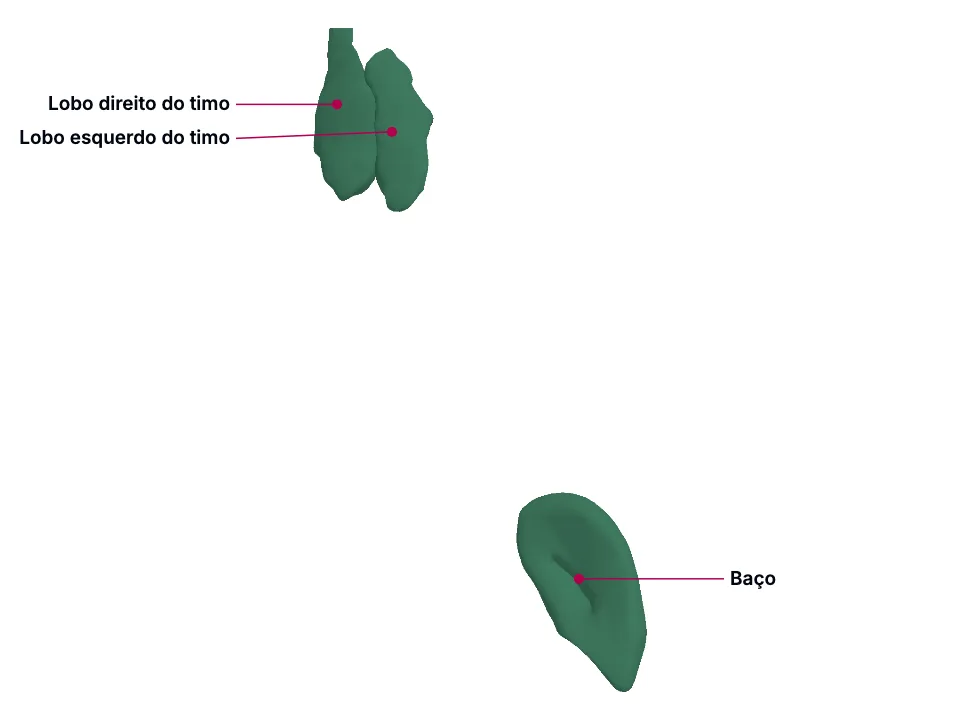
O baço é o maior órgão linfoide secundário: filtra o sangue na polpa vermelha, remove hemácias senescentes e retém cerca de um terço das plaquetas (sem reservatório de hemácias no baço humano), e sua posição sob a 9ª à 11ª costela o expõe a perfuração por fratura de costela baixa no trauma abdominal fechado. O timo é o órgão linfoide primário em que os linfócitos T passam por seleção positiva (córtex, reconhecimento do complexo peptídeo próprio-MHC) e negativa (medula, eliminação dos autorreativos) e que involui para tecido adiposo a partir da puberdade. Esta unidade cobre só esses tópicos, em ciência básica, sem ligamentos, vascularização e relações viscerais do baço, asplenia, nem embriologia e clínica do timo, e o acervo 3D modela só baço e timo, sem linfonodo, tonsila, ducto torácico ou medula óssea.
Educational material written with AI support and checked by automated review, without a named medical reviewer. It does not replace the textbook or clinical guidance.
Essential
O baço é o maior órgão linfoide SECUNDÁRIO do corpo humano adulto: 'The spleen is the largest secondary lymphoid organ; although only 0.3% of body weight, the spleen receives 3.5% of the cardiac output.' Ele filtra o sangue nos cordões esplênicos, na polpa vermelha: 'Filtration of erythrocytes and platelets occurs via splenic cords in the red pulp.'
Nessa filtração, hemácias jovens e flexíveis atravessam os cordões e voltam à circulação, enquanto as senescentes e danificadas ficam retidas e são removidas: 'facilitating the removal of senescent, damaged, or otherwise defective red blood cells' Ao contrário do que se lê em textos de fisiologia animal, o baço humano não funciona como reservatório de hemácias: 'There is no storage function for red cells in the human spleen. The human erythrocyte has an average life span of about 120 days. In other species, such as dogs and seals, large amounts of red cells are stored in the spleen at rest.'
O baço fica no hipocôndrio esquerdo, entre o diafragma e o fundo gástrico, tipicamente sob a 9ª à 11ª costela: 'The spleen constitutes the largest organ of the lymphatic system, located in the left hypochondriac region between the diaphragm and gastric fundus, typically spanning the ninth to 11th ribs.'
Essa mesma vizinhança óssea que o protege é o que o torna vulnerável: uma fratura de costela baixa à esquerda pode, ela mesma, perfurar o baço: 'Splenic rupture should be carefully considered in cases of left rib fractures, as displacement of a rib fragment can puncture the spleen.' A associação é quantificada por uma segunda fonte, sobre o assunto do trauma: 'In adults, up to 20% of patients with lower left rib fractures have associated splenic trauma.'
O timo é o órgão linfoide PRIMÁRIO do recorte: 'The primary lymphoid organs are the bone marrow and thymus gland. The lymphoid organs are where lymphocytes mature, proliferate, and are selected, which enables them to attack pathogens without harming the cells of the body.' Ele fica no espaço entre o esterno e a aorta: 'The thymus gland is a bilobed organ found in the space between the sternum and the aorta of the heart' Ele fornece progenitores que amadurecem em linfócitos T funcionais: 'This organ supplies progenitor cells to peripheral lymphoid tissues and supports their maturation and functional competence.'
Essa maturação passa por duas etapas de seleção: 'T-cell development within the thymus involves both positive and negative selection.' A positiva ocorre no córtex: o linfócito precisa reconhecer o complexo peptídeo próprio-MHC apresentado pelas células epiteliais corticais, o que gera a restrição ao MHC: 'Interaction between the TCR and self-peptide/MHC complexes in the thymus dictates the fate of the developing thymocytes' - 'cTECs express a unique proteasome and lysosomal proteases, which enable the production and presentation of a unique set of self-peptides for the positive selection of a diverse TCR repertoire' A negativa ocorre na medula e elimina (ou desvia para linfócitos T reguladores) os autorreativos: 'This unique trait of mTECs ensures the negative selection and/or Treg conversion of self-reactive SP thymocytes that recognize such TRAs' Em conjunto: 'Collectively, the thymic cortex promotes the generation of a diverse TCR repertoire, while the thymic medulla establishes the self-tolerance of T cells.'
In the clinic
O que o baço humano retém em volume relevante são plaquetas, na polpa vermelha: 'There are about 1/3 of all platelets at a given time in the red pulp. Therefore, hypersplenism can lead to thrombocytopenia in the blood' Um baço aumentado pode, portanto, baixar a contagem de plaquetas circulantes sem que a medula esteja produzindo menos.
É por isso que o baço está entre os órgãos mais lesados no trauma abdominal fechado: 'The spleen is one of the most commonly injured organs in blunt abdominal trauma.' Diante de uma fratura de costela baixa à esquerda no trauma fechado, a lesão esplênica entra na lista de suspeitas, na proporção descrita acima.
Ao contrário da maioria dos órgãos, o timo atinge maturação plena ainda no útero e, a partir da puberdade, entra em involução progressiva: 'Unlike most other human organs, the thymus reaches full maturation in utero and undergoes progressive involution beginning around puberty.' - 'This process involves structural remodeling, during which organized parenchyma is gradually replaced by adipose tissue as immunologic activity declines.' Um capítulo StatPearls diferente, sobre um assunto diferente (a neoplasia do timo, não sua anatomia normal), concorda no mesmo detalhe: 'The thymus is vital in the development of the adaptive immune system and commonly involutes after puberty into fibrofatty tissue.' Por isso um timo pequeno e gorduroso num exame de imagem do adulto é achado esperado, não doença: 'Largest during early life, the thymus gradually decreases in size after puberty and undergoes fibrofatty replacement, accompanied by diminished immunologic function.'
Open the deeper layer
Going deeper
Baço e timo dividem o mesmo recorte do acervo 3D e o mesmo rótulo - 'órgão linfoide' -, mas essa classificação comum esconde papéis e trajetórias de vida opostos dentro do sistema imune.
O baço é órgão linfoide SECUNDÁRIO (periférico): 'The spleen is the largest secondary lymphoid organ; although only 0.3% of body weight, the spleen receives 3.5% of the cardiac output.' Continua ativo a vida inteira, filtrando hemácias senescentes dos cordões esplênicos e retendo plaquetas na polpa vermelha: 'Filtration of erythrocytes and platelets occurs via splenic cords in the red pulp.' - 'There are about 1/3 of all platelets at a given time in the red pulp. Therefore, hypersplenism can lead to thrombocytopenia in the blood'; O timo é órgão linfoide PRIMÁRIO (central): 'The primary lymphoid organs are the bone marrow and thymus gland. The lymphoid organs are where lymphocytes mature, proliferate, and are selected, which enables them to attack pathogens without harming the cells of the body.' Diferente do baço, ele é mais ativo justamente no início da vida - amadurece linfócitos T por seleção positiva e negativa: 'T-cell development within the thymus involves both positive and negative selection.' - e depois REGRIDE: entra em involução progressiva a partir da puberdade, substituído por tecido adiposo: 'Unlike most other human organs, the thymus reaches full maturation in utero and undergoes progressive involution beginning around puberty.'
Test yourself before moving on
Um paciente com cirrose e hipertensão portal tem plaquetas baixas, mas a medula óssea produz plaquetas normalmente. Que papel do baço sobre as plaquetas explica esse achado, e o que se pode afirmar sobre o armazenamento de hemácias no baço humano?
The answer stays in Assessment, with no spoiler here.
Answer in AssessmentSources (8)
- Pabst R. Clinical relevance of the compartments and lymphocyte subsets in the human spleen. Cell Tissue Res. 2025;402:109-119.
The spleen is the largest secondary lymphoid organ; although only 0.3% of body weight, the spleen receives 3.5% of the cardiac output.
- Kapila V, Wehrle CJ, Tuma F. Physiology, Spleen. [Updated 2023 May 1]. In: StatPearls [Internet]. Treasure Island (FL): StatPearls Publishing; 2026 Jan-.
Filtration of erythrocytes and platelets occurs via splenic cords in the red pulp.
- Omole AE, Launico MV. Anatomy, Abdomen and Pelvis, Spleen. [Updated 2026 Jan 31]. In: StatPearls [Internet]. Treasure Island (FL): StatPearls Publishing; 2026 Jan-.
facilitating the removal of senescent, damaged, or otherwise defective red blood cells
- Oelhaf RC, Wang CF, King KC. Splenic Trauma. [Updated 2025 Jun 2]. In: StatPearls [Internet]. Treasure Island (FL): StatPearls Publishing; 2026 Jan-.
In adults, up to 20% of patients with lower left rib fractures have associated splenic trauma.
- Betts JG, Young KA, Wise JA, Johnson E, Poe B, Kruse DH, Korol O, Johnson JE, Womble M, DeSaix P. Anatomy and Physiology 2e. Houston: OpenStax; 2022. Section 21.1, Anatomy of the Lymphatic and Immune Systems.
The primary lymphoid organs are the bone marrow and thymus gland. The lymphoid organs are where lymphocytes mature, proliferate, and are selected, which enables them to attack pathogens without harming the cells of the body.
- Remien K, Jozsa F, Jan A. Anatomy, Head and Neck, Thymus. [Updated 2025 Jun 23]. In: StatPearls [Internet]. Treasure Island (FL): StatPearls Publishing; 2026 Jan-.
This organ supplies progenitor cells to peripheral lymphoid tissues and supports their maturation and functional competence.
- Nitta T, Takayanagi H. Non-Epithelial Thymic Stromal Cells: Unsung Heroes in Thymus Organogenesis and T Cell Development. Front Immunol. 2020;11:620894.
Interaction between the TCR and self-peptide/MHC complexes in the thymus dictates the fate of the developing thymocytes
- Robinson SP, Akhondi H. Thymoma. [Updated 2023 Jul 17]. In: StatPearls [Internet]. Treasure Island (FL): StatPearls Publishing; 2026 Jan-.
The thymus is vital in the development of the adaptive immune system and commonly involutes after puberty into fibrofatty tissue.
More Anatomia summaries
After reading, use what you learned
Atlas
See the structures of the topic in 3D and move through the layers.
Clinical case
Apply the content to an on-call decision.
Exam
Read the result that closes the reasoning.
Assessment
Answer the block questions and see where you stand.
AI tutor
Ask about what the text did not settle.
Start free: create an account and try a sample of the 3D Atlas, the clinical case, the exam, the assessment and the AI tutor. No credit card.
Start free