Circuito de Papez e memória: hipocampo, fórnix, corpo mamilar e giro do cíngulo
In 30 seconds
O hipocampo envia pelo fornix a informação de memória até o corpo mamilar, que a repassa ao núcleo talâmico anterior e ao giro do cíngulo antes de voltar ao próprio hipocampo pelo córtex entorrinal - um circuito FECHADO (Papez) em que lesões do fornix ou do corpo mamilar, como a do hipocampo, produzem amnésia anterógrada.
Scope and method of this summary
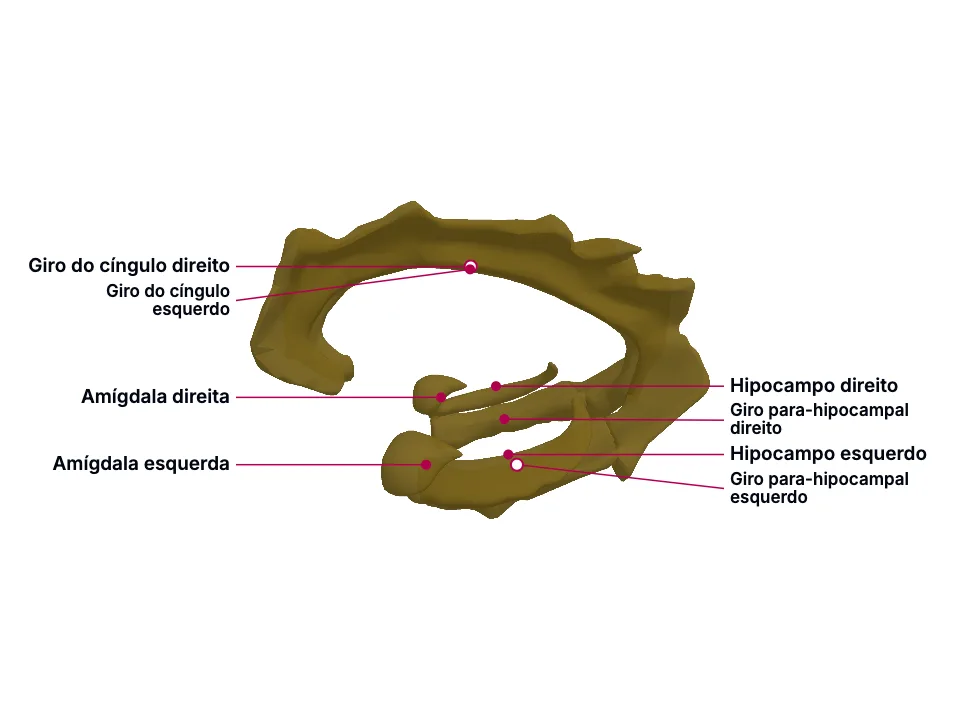
O hipocampo envia pelo fornix a informação de memória até o corpo mamilar, que a repassa ao núcleo talâmico anterior e ao giro do cíngulo antes de voltar ao próprio hipocampo pelo córtex entorrinal - um circuito FECHADO (Papez) em que lesões do fornix ou do corpo mamilar, como a do hipocampo, produzem amnésia anterógrada. A amígdala e o giro para-hipocampal são vizinhos anatômicos do hipocampo que a cirurgia de epilepsia pode ressecar junto com ele. Por fora do circuito de memória, o giro do cíngulo - por envolver o corpo caloso bem na face medial do hemisfério - e a estrutura que se desloca sob a foice do cérebro na herniação subfalcina, a síndrome de herniação mais comum.
Educational material written with AI support and checked by automated review, without a named medical reviewer. It does not replace the textbook or clinical guidance.
Essential
O circuito de Papez é um LOOP fechado, não uma via de mão única: 'memory information originates in the hippocampus, where θ waves activate CA3 neurons. Information is conveyed through the fornix to the mammillary bodies. Projections from the mammillary bodies reach the anterior thalamic nuclei via the mammillothalamic tract. The anterior thalamic nuclei project to the cingulate cortex, which, in turn, projects to the entorhinal cortex. A bidirectional projection between the hippocampus and entorhinal cortex completes the Papez circuit.' A fonte nomeia o circuito por extenso: 'it forms a crucial part of the so-called Papez circuit, a fundamental connective network governing emotional function, linking the hippocampal formation, fornix, anterior thalamic nucleus, cingulum, and entorhinal cortex', proposto originalmente por James Papez - 'this was originally proposed by the neuroanatomist James Papez, who theorized the need for a circuit connecting the hypothalamus, limbic lobe, and brainstem for emotional processing.'
Por ser um ANEL fechado - hipocampo -> fornix -> corpo mamilar -> núcleo talâmico anterior -> giro do cíngulo -> córtex entorrinal -> de volta ao hipocampo -, o circuito não tem um único ponto de falha: 'lesions of the fornix or mammillary bodies disrupt these circuits and produce amnésia' - a fonte documenta a amnésia para lesões do fórnix e dos corpos mamilares, não só do hipocampo que dá nome ao sintoma mais conhecido (a lesão bilateral do eixo hipocampo-fórnix-corpo mamilar interrompe o circuito). Isso não autoriza generalizar a qualquer outro nó do anel: a fonte não afirma isso. É por isso que duas doenças com mecanismo de lesão completamente diferente - uma cirúrgica, outra metabólica - ambas produzem amnésia anterógrada: elas atingem pontos diferentes do mesmo circuito.
O hipocampo tem cerca de cinco centímetros e começa exatamente onde a amígdala está: 'this five-centimeter-long hippocampus (from the anterior end at the amygdala to the posterior end near the splenium of the corpus callosum) divides into a head, body, and tail.' A própria amígdala confirma a vizinhança do outro lado: 'anatomically, the amygdala lies at the anterior border of the hippocampal formation and the anterior aspect of the lateral ventricle's inferior horn where it merges with the peri-amygdaloid cortex, which forms part of the surface of the uncus.'
Como as duas estruturas se fundem fisicamente pelo córtex peri-amigdaloide na superfície do unco - não apenas ficam perto -, uma cirurgia que retira o hipocampo está anatomicamente colada à amígdala e ao giro para-hipocampal, e por isso a peça ressecada pode incluí-los. A vizinhança não é um detalhe descritivo: é o que decide a TÉCNICA cirúrgica.
O giro do cíngulo envolve o corpo caloso como um cinto, na face medial de cada hemisfério: 'as the Latin translation of cingulate would suggest, the cingulate gyrus wraps around the corpus callosum like a belt. It begins beneath the rostrum of the corpus callosum, curves around the genu, and projects above the superior surface of the body of the corpus callosum, reaching its posterior end where it terminates at the isthmus of the cingulate gyrus.'
O crânio é um compartimento fixo, subdividido por septos durais rígidos como a foice do cérebro (falx cerebri). Por estar bem na face medial do hemisfério, junto à foice, o giro do cíngulo é a primeira estrutura empurrada para o lado oposto quando a pressão intracraniana sobe de um lado: 'the most common brain herniation syndrome is subfalcine herniation, in which raised ICP forces a cerebral hemisphere to the opposite side of the cranium, forcing the cingulate gyrus beneath the free edge of the falx cerebri.' A direção do deslocamento também se explica pela anatomia da própria foice: 'this happens anteriorly because the falx cerebri is rigid posteriorly, so the herniation occurs preferentially anteriorly, where there is less resistance from the falx cerebri.'
In the clinic
No caso 'H.M.', a lesão foi no próprio hipocampo: 'In 1953, a patient who was known as H.M. had the anterior two-thirds of bilateral hippocampi resected in an attempt to cure his epilepsy. While he experienced a partial reduction of his epilepsy, for the remainder of his life, he was unable to form new memories.' No Wernicke-Korsakoff, a lesão é no corpo mamilar, por deficiência de tiamina - 'thiamine deficiency is a common cause of Korsakoff syndrome' -, e o resultado bilateral é o mesmo padrão de amnésia: 'bilateral damage leads to anterograde amnésia, which can occur independently or alongside additional symptoms, including reckless behavior, reduced motivation, and confabulation.' O quadro agudo que precede o Korsakoff tem sinais próprios que não vem do circuito de memória: 'the condition presents with a triad of ophthalmoplegia, ataxia, and altered mental status', e sem tratamento 'may progress to chronic Korsakoff syndrome, at which point amnésia symptoms are often irreversible.'
Na epilepsia do lobo temporal por esclerose hipocampal, a indicação é retirar o hipocampo - 'a hippocampectomy is a surgical procedure to excise the hippocampus in patients with medial temporal epilepsy due to hippocampal sclerosis' -, mas a técnica recomendada RESSECA também vizinhas: 'subpial resection of the hippocampus and perhaps some surrounding structures, like the amygdaloid complex and parahippocampal gyrus, is recommended in this procedure while avoiding lesions to important surrounding landmarks.' A dificuldade técnica vem da mesma vizinhança apertada: 'the hippocampus is only viewable from the inferior horn of the lateral ventricle, which makes a resection especially challenging and complex.'
Quando a herniação subfalcina progride, a artéria cerebral anterior - que corre junto a essa mesma face medial - pode ser comprimida contra a foice: 'although it does not usually produce severe symptomatology, if subfalcine herniation progresses, it can be further complicated by compression of the anterior cerebral artery (ACA) against the falx, resulting in an ipsilateral ACA stroke, which most commonly manifests as contralateral leg weakness.'
Open the deeper layer
Going deeper
O prosencéfalo (cérebro anterior), que se diferencia em telencéfalo e diencéfalo. A divisão é descrita a partir do tubo neural: 'in addition to the spinal cord, the neural tube differentiates into three primary vesicles for the forebrain, midbrain, and hindbrain. The forebrain further differentiates into the telencephalon and diencephalon; the midbrain continues to be the mesencephalon, and the hindbrain becomes the metencephalon and myelencephalon.'
Giro do cíngulo - diferencia-se diretamente do telencéfalo, na face medial dos dois hemisférios cerebrais que ele origina: 'the telencephalon differentiates into the 2 cerebral hemispheres, which include the cingulate gyrus on their medial surface.'; Hipocampo - origina-se no isocortex, como parte do quinto lobo límbico, também considerado parte do córtex olfatório: 'the hippocampus originates in the isocortex as part of the fifth limbic lobe of the brain in the cerebral hemisphere's medial surface. It is also considered part of the olfactory cortex.' (NOTA: a fonte chama o hipocampo de isocórtex; a classificação histológica padrão o trata como arquicórtex/alocórtex, não isocórtex/neocórtex — imprecisão da própria fonte, mantida aqui por fidelidade à citação literal.); Amígdala - derivado telencefálico, como o giro do cíngulo e o hipocampo: 'the telencephalon gives rise to the amygdala while neurons from the diencephalon migrate to further develop it.'; Corpo mamilar - origina-se do diencéfalo, junto com o hipotálamo e a hipófise posterior: 'the hypothalamus, mammillary bodies, and posterior pituitary originate from the diencephalon.' E o único dos quatro co-derivados desta lista que NÃO vem do telencéfalo.
Test yourself before moving on
Começando no hipocampo, nomeie na ordem as estruturas do circuito de Papez até ele se fechar de volta no hipocampo.
The answer stays in Assessment, with no spoiler here.
Answer in AssessmentSources (5)
- Peterson DC, Omole AE, Mayes DA. Neuroanatomy, Mammillary Bodies. [Updated 2025 Dec 14]. In: StatPearls [Internet]. Treasure Island (FL): StatPearls Publishing; 2026 Jan-.
Memory information originates in the hippocampus, where θ waves activate CA3 neurons. Information is conveyed through the fornix to the mammillary bodies. Projections from the mammillary bodies reach the anterior thalamic nuclei via the mammillothalamic tract. The anterior thalamic nuclei project to…
- Jumah FR, Dossani RH. Neuroanatomy, Cingulate Cortex. [Updated 2022 Dec 6]. In: StatPearls [Internet]. Treasure Island (FL): StatPearls Publishing; 2026 Jan-.
it forms a crucial part of the so-called 'Papez circuit,' a fundamental connective network governing emotional function, linking the hippocampal formation, fornix, anterior thalamic nucleus, cingulum, and entorhinal cortex.
- Torrico TJ, Abdijadid S. Neuroanatomy, Limbic System. [Updated 2023 Jul 17]. In: StatPearls [Internet]. Treasure Island (FL): StatPearls Publishing; 2026 Jan-.
In 1953, a patient who was known as "H.M." had the anterior two-thirds of bilateral hippocampi resected in an attempt to cure his epilepsy. While he experienced a partial reduction of his epilepsy, for the remainder of his life, he was unable to form new memories.
- Fogwe LA, Reddy V, Mesfin FB. Neuroanatomy, Hippocampus. [Updated 2023 Jul 20]. In: StatPearls [Internet]. Treasure Island (FL): StatPearls Publishing; 2026 Jan-.
This five-centimeter-long hippocampus (from the anterior end at the amygdala to the posterior end near the splenium of the corpus callosum) divides into a head, body, and tail.
- AbuHasan Q, Reddy V, Siddiqui W. Neuroanatomy, Amygdala. [Updated 2023 Jul 17]. In: StatPearls [Internet]. Treasure Island (FL): StatPearls Publishing; 2026 Jan-.
Anatomically, the amygdala lies at the anterior border of the hippocampal formation and the anterior aspect of the lateral ventricle's inferior horn where it merges with the peri-amygdaloid cortex, which forms part of the surface of the uncus.
More Anatomia summaries
After reading, use what you learned
Atlas
See the structures of the topic in 3D and move through the layers.
Clinical case
Apply the content to an on-call decision.
Exam
Read the result that closes the reasoning.
Assessment
Answer the block questions and see where you stand.
AI tutor
Ask about what the text did not settle.
Start free: create an account and try a sample of the 3D Atlas, the clinical case, the exam, the assessment and the AI tutor. No credit card.
Start free