Marcha de Trendelenburg e síndrome do piriforme: quando o quadril trai o exame de pé
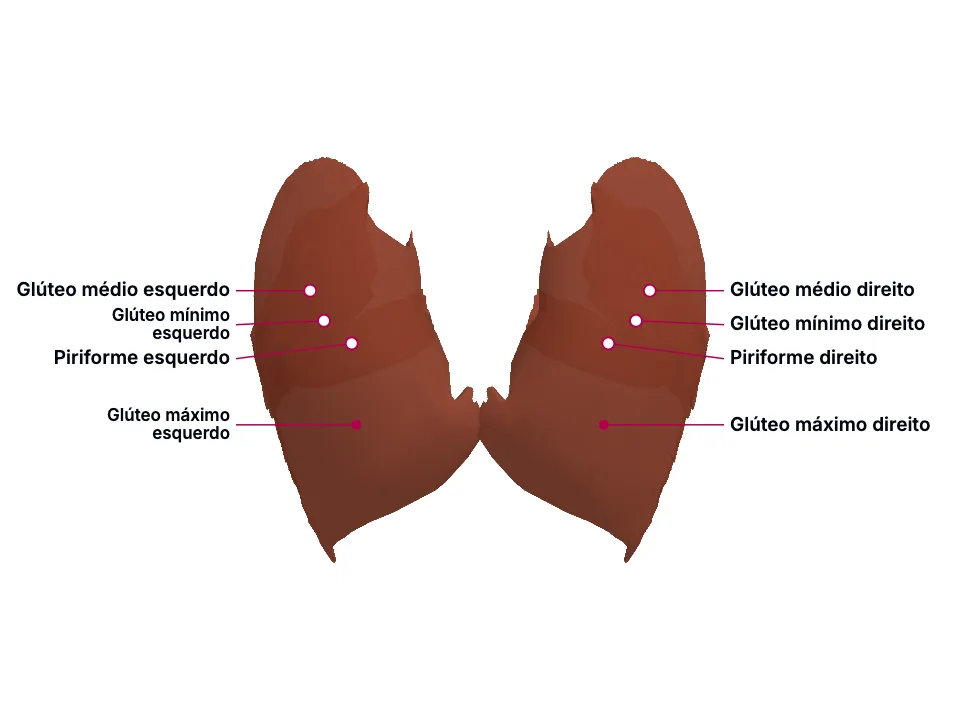
O glúteo médio e o glúteo mínimo estabilizam a pelve durante o apoio unipodal da marcha, e sua fraqueza (por lesão do nervo glúteo superior) produz o sinal de Trendelenburg (queda pélvica no lado OPOSTO ao músculo fraco) e, em casos graves, a marcha compensatória de Trendelenburg (o tronco se inclina PARA o lado fraco) - diferente do glúteo máximo, inervado por um nervo exclusivo (glúteo inferior) e sem participação nesse mecanismo abdutor. O nervo isquiático tem relação anatômica variável com o piriforme - a maioria das pessoas o tem passando por baixo do músculo, mas numa minoria variante ele já se divide e atravessa o próprio ventre muscular antes de sair da pelve - a base anatômica da síndrome do piriforme (dor glútea que se irradia como ciática, mas sem hérnia de disco). O iliopsoas (psoas maior + ilíaco) é o flexor primário do quadril, e sua fáscia se funde com a fáscia do ceco e do cólon ascendente - a vizinhança anatômica por trás do sinal do psoas (dor à extensão passiva do quadril, sugerindo irritação do músculo por um apêndice inflamado próximo).
Educational material written with AI support and checked by automated review, without a named medical reviewer. It does not replace the textbook or clinical guidance.
Essential
O glúteo médio e o glúteo mínimo trabalham juntos como abdutores do quadril: 'The musculature is formed principally by the 3 gluteal muscles: Maximus, medius, and minimus. The Gluteus medius and minimus work together as hip abductors and are vital to normal locomotion' O glúteo mínimo compartilha essa estrutura e função com o médio: 'It shares many similar characteristics with the gluteus medius, including structure and function, blood supply, and innervation.' - e ambos atuam como estabilizadores do quadril: 'The gluteus minimus predominantly acts as a hip stabilizer and abductor of the hip.'
Os dois músculos são inervados pelo mesmo nervo: 'The gluteus medius receives its nerve supply from the superior gluteal nerve. The superior gluteal nerve originates from the dorsal branches of the L4, L5, and S1 nerve roots of the sacral plexus.' Durante a fase de apoio unipodal da marcha, eles contraem do lado que sustenta o peso para impedir que a pelve caia do lado SEM apoio: 'Gluteus medius acts on the femur to stabilize the pelvis and maintain upright trunk posture during standing, running, and walking when 1 leg is off the ground. With 1 foot off the ground, the body's weight tends to cause the pelvis to sag downward on the unsupported side. The gluteus medius and minimus of the supported side counteract this force by powerful traction on the hip bone. The pelvis is prevented from sagging downward and may even be slightly raised on the unsupported side.' O glúteo mínimo, especificamente, é o que fica engajado do lado de apoio, mantendo a pelve nivelada durante o balanço da perna oposta: 'The gluteus minimus is engaged on the supported side, which allows the pelvis to remain level during the swing phase of gait.'
A marcha de Trendelenburg nasce de um defeito no mecanismo abdutor do quadril: 'Trendelenburg gait is an abnormal gait resulting from a defective hip abductor mechanism.' Esse mecanismo se comporta como uma alavanca simples: 'The hip joint and its abductor mechanism behave like a class 1 lever with the effort and the load on opposing sides of the fulcrum.'
Durante a fase de balanço, o peso do corpo tenderia a derrubar a pelve do lado sem apoio, e é o glúteo médio/mínimo do lado de apoio que evita essa queda: 'When one foot lifts off the ground, as during the swing phase of the gait cycle, the body remains unsupported on that side, and the pelvis tends to drop to the unsupported side. To prevent the drop, the abductor muscles, mainly the gluteus medius and minimus on the supported side contract, providing stabilization of the superimposed trunk.' Quando esse mecanismo está gravemente comprometido, o paciente compensa inclinando o tronco: 'If the limp is severe, there is compensatory bending or lurching to the side of the pathology to balance the body's center of gravity. This limp is called the lurching gait.' - especificamente PARA o lado doente (o lado de apoio, o mesmo lado do músculo fraco), não para o lado da queda pélvica: 'The pelvis drops towards the unsupported side when the abductor mechanism is weak. The patient leans towards the affected side in case of more serious weakness.'
O piriforme é um músculo pequeno e piriforme na região glútea: 'The piriformis is a flat, pear-shaped muscle located in the gluteal region.' Ele passa pelo forame isquiático maior e serve de referência anatômica: os nervos da região levam o nome pela relação espacial com ele: 'The muscle passes through the greater sciatic foramen, nearly fills the notch, and divides it into superior and inferior segments. Some gluteal nerves and blood vessels derive their names from their anatomic relationship with the piriformis. For example, the superior gluteal nerve and vessels pass superior to the piriformis. The inferior gluteal nerve and vessels transit inferiorly. All the other nerves and blood vessels exit the pelvis inferior to the piriformis.'
O nervo isquiático, especificamente, passa por baixo do piriforme na maioria das pessoas, mas com variações: 'The sciatic nerve generally exits the pelvis inferior to the piriformis muscle. However, variations occur, and the entire nerve may pass superior to or through the muscle.' - 'It exits the pelvis through the greater sciatic foramen inferior to the piriformis muscle along with the pudendal nerve and vessels, inferior gluteal nerve and vessels, nerve to obturator internus, and posterior femoral cutaneous nerve.' Quantificando essa variação: 'The sciatic nerve pierces the piriformis in different locations in at least a fifth of the population.' e, de forma consistente, 'In >80% of the population, the sciatic nerve courses deep to and exits inferiorly to the piriformis muscle belly/tendon' Em algumas dessas variações, o nervo já vem dividido antes de sair da pelve: 'Early (proximal) divisions of the sciatic nerve into its tibial and common peroneal components can predispose patients to piriformis syndrome, with these branches passing through and below the piriformis muscle or above and below the muscle'
O psoas maior e o ilíaco, juntos, formam o iliopsoas - o flexor primário do quadril: 'The iliopsoas musculotendinous unit (IPMU), composed of the psoas major, psoas minor, and iliacus muscles, functions as the primary flexor of the thigh and contributes to external rotation and stabilization of the hip and lumbar spine' Cada um tem origem própria, convergindo no mesmo tendão: 'The psoas major originates from the lumbar vertebrae, while the iliacus arises from the iliac fossa. Both insert onto the lesser trochanter.' e, juntos, também contribuem para adução e rotação externa do quadril: 'The IPMU is the primary flexor of the thigh and contributes to adduction and external rotation of the coxofemoral joint.'
Apesar de agirem juntos, os dois músculos são inervados por fontes diferentes: 'The short collateral branches of the lumbar plexus (L1–L3) innervate the psoas major and minor. The iliacus is innervated by the femoral nerve, the terminal branch of the lumbar plexus (L1–L4).' O psoas maior também estabiliza a cabeça do fêmur dentro do acetábulo: 'The psoas major also stabilizes the femoral head within the acetabulum during the initial 15° of movement.' E a fáscia do iliopsoas se funde, na parte anterior, com a fáscia de vísceras retroperitoneais - incluindo o ceco e o cólon ascendente: 'Anteriorly, the IPMU fascia merges with the fascia covering the kidneys, pancreas, descending aorta, inferior vena cava, ascending and descending colon, duodenum, and cecum.'
In the clinic
Quando esse mecanismo abdutor falha - por fraqueza muscular ou por lesão do nervo glúteo superior -, a pelve do lado SEM apoio cai quando o paciente fica sobre a perna doente: 'When either of these conditions is affected, the pelvis sinks downward on the unsupported side when the patient stands on the affected limb, a sign known as the Trendelenburg sign.' - 'Damage to the nerve or muscle may result in sagging of the pelvis, also known as the Trendelenburg sign.' A repetição desse padrão a cada passo produz uma marcha característica: 'In cases of paralysis of the gluteus medius and minimus, patients exhibit a characteristic lurching gait known as the Trendelenburg gait.'
O terceiro músculo glúteo, o máximo, tem uma ação diferente - extensão do quadril, não abdução: 'The principal function of the gluteus maximus is as the chief antigravity muscle during sitting by counteracting and controlling the flexion of the hip. Its main actions are to extend and externally rotate the thigh.' - e uma inervação exclusiva de um nervo diferente: 'The innervation of the gluteus maximus muscle is from the inferior gluteal nerve, the only muscle this nerve innervates. The inferior gluteal nerve originates from the ventral rami of L5, S1, and S2. The nerve emerges from the inferior border of the piriformis. In contrast, its counterpart, the superior gluteal nerve, emerges from the superior border of this muscle along with the superior gluteal artery.' Como o mecanismo de Trendelenburg é atribuído especificamente ao glúteo médio/mínimo e ao nervo glúteo superior - nunca ao glúteo máximo ou ao nervo glúteo inferior -, uma lesão isolada do glúteo máximo não reproduz o sinal nem a marcha de Trendelenburg, mesmo comprometendo a extensão do quadril (subir escadas, levantar de uma cadeira): 'Examples of activities that require the gluteus maximus to act as an extensor include rising from a seated position, straightening from a bent position, walking upstairs or on a hill, and running.'
Como o nervo isquiático corre bem próximo ao piriforme, a irritação ou inflamação do músculo afeta o nervo: 'The sciatic nerve runs just adjacent to the piriformis muscle, which functions as an external rotator of the hip. Hence, whenever the piriformis muscle is irritated or inflamed, it also affects the sciatic nerve, which then results in sciatica-like pain.' produzindo o quadro conhecido como síndrome do piriforme: 'Piriformis syndrome is a clinical condition of sciatic nerve entrapment at the level of the ischial tuberosity.' Diferente da ciática de origem espinhal - 'Sciatica is defined as irritation or compression of the sciatic nerve that causes pain in the buttock area with radiation to the lower leg. The vast majority of cases have a spinal cause, such as disc herniation or rupture causing L5 or S1 nerve root impingement.' -, a síndrome do piriforme é uma causa NÃO espinhal do mesmo tipo de dor: 'There are also many non-spinal causes of sciatica, which are less common. These include piriformis syndrome, trauma, postoperative complications, gynecologic conditions, and herpes zoster.'
É essa vizinhança fascial com o ceco que explica por que um apêndice inflamado pode irritar o músculo psoas e produzir dor à extensão do quadril: 'A positive psoas sign is right lower quadrant pain with right hip extension or right thigh flexion against resistance. This pain occurs due to irritation of the psoas muscle by the inflamed appendix.' O mesmo achado - dor à extensão passiva do quadril - também aparece quando a irritação é do próprio músculo, sem relação com o apêndice: 'Although traditionally associated with appendicitis, a positive psoas sign—pain elicited during passive hip extension—may also indicate psoas muscle irritation and support a diagnosis of psoas syndrome.' e, mais raramente, por um abscesso do psoas: 'Less common causes, including psoas abscess or retroperitoneal malignancy, should be considered in atypical or refractory presentations.'
Open the deeper layer
Going deeper
O piriforme funciona como ponto de referência anatômico dentro do forame isquiático maior - os nervos que saem da pelve nessa região são descritos pela relação espacial com ele: 'The muscle passes through the greater sciatic foramen, nearly fills the notch, and divides it into superior and inferior segments. Some gluteal nerves and blood vessels derive their names from their anatomic relationship with the piriformis. For example, the superior gluteal nerve and vessels pass superior to the piriformis. The inferior gluteal nerve and vessels transit inferiorly. All the other nerves and blood vessels exit the pelvis inferior to the piriformis.' O nervo glúteo superior é, nesse sentido, único: 'The superior gluteal nerve is unique in that it is the only nerve to exit through the greater sciatic foramen superior to the piriformis muscle. All other nerves which exit through the greater sciatic foramen, such as the pudendal nerve, inferior gluteal nerve, and sciatic nerve, do so inferior to the piriformis.'
Nervo glúteo superior - sai ACIMA do piriforme, origem no plexo sacral: 'The superior gluteal nerve is found in the lower pelvis and arises from the dorsal divisions of the L4, L5, and S1 nerve roots of the sacral plexus.' Inerva especificamente glúteo médio, mínimo e tensor da fáscia lata: 'The superior gluteal nerve is responsible for innervation of the gluteus medius, gluteus minimus, and tensor fasciae latae muscles.' - o grupo ABDUTOR responsável pelo mecanismo do sinal e da marcha de Trendelenburg: 'Damage to the superior gluteal nerve results in paralysis of the gluteus medius muscle, resulting in a characteristic gait on walking and standing known as the Trendelenburg gait.'; Nervo glúteo inferior - sai ABAIXO do piriforme, e inerva EXCLUSIVAMENTE o glúteo máximo: 'The innervation of the gluteus maximus muscle is from the inferior gluteal nerve, the only muscle this nerve innervates. The inferior gluteal nerve originates from the ventral rami of L5, S1, and S2. The nerve emerges from the inferior border of the piriformis. In contrast, its counterpart, the superior gluteal nerve, emerges from the superior border of this muscle along with the superior gluteal artery.' - o extensor do quadril, sem participação no mecanismo abdutor de estabilização pélvica.; Nervo isquiático - também sai, na maioria das pessoas, abaixo do piriforme, inteiro: 'Type I: sciatic nerve exits inferior to piriformis, undivided. This is the most common form.' Mas numa minoria variante, ele já se divide ANTES de sair da pelve, e um dos ramos atravessa o próprio ventre muscular: 'Type II: sciatic nerve divides above piriformis; one portion exits through the piriformis, the other inferior to it. The common fibular (peroneal) division passes through the piriformis.' - 'In 10%, the sciatic nerve passed through or above the piriformis.' Essa variação anatômica é a base da síndrome do piriforme: 'Early (proximal) divisions of the sciatic nerve into its tibial and common peroneal components can predispose patients to piriformis syndrome, with these branches passing through and below the piriformis muscle or above and below the muscle'
Test yourself before moving on
Ao pedir que uma paciente fique em apoio unipodal sobre a perna DIREITA, o examinador nota que a pelve do lado ESQUERDO cai visivelmente. De que lado está o músculo fraco, e qual nervo o inerva?
The answer stays in Assessment, with no spoiler here.
Answer in AssessmentSources (11)
- Shah A, Bordoni B. Anatomy, Bony Pelvis and Lower Limb, Gluteus Medius Muscle. [Updated 2023 Feb 17]. In: StatPearls [Internet]. Treasure Island (FL): StatPearls Publishing; 2026 Jan-.
The musculature is formed principally by the 3 gluteal muscles: Maximus, medius, and minimus. The Gluteus medius and minimus work together as hip abductors and are vital to normal locomotion
- Greco AJ, Vilella RC. Anatomy, Bony Pelvis and Lower Limb, Gluteus Minimus Muscle. [Updated 2023 May 22]. In: StatPearls [Internet]. Treasure Island (FL): StatPearls Publishing; 2026 Jan-.
It shares many similar characteristics with the gluteus medius, including structure and function, blood supply, and innervation.
- Gandbhir VN, Lam JC, Lui F, Rayi A. Trendelenburg Gait. [Updated 2024 Feb 29]. In: StatPearls [Internet]. Treasure Island (FL): StatPearls Publishing; 2026 Jan-.
Trendelenburg gait is an abnormal gait resulting from a defective hip abductor mechanism.
- Elzanie A, Borger J. Anatomy, Bony Pelvis and Lower Limb, Gluteus Maximus Muscle. [Updated 2023 Apr 1]. In: StatPearls [Internet]. Treasure Island (FL): StatPearls Publishing; 2026 Jan-.
The principal function of the gluteus maximus is as the chief antigravity muscle during sitting by counteracting and controlling the flexion of the hip. Its main actions are to extend and externally rotate the thigh.
- Chang C, Jeno SH, Varacallo MA. Anatomy, Bony Pelvis and Lower Limb: Piriformis Muscle. [Updated 2023 Nov 13]. In: StatPearls [Internet]. Treasure Island (FL): StatPearls Publishing; 2026 Jan-.
The piriformis is a flat, pear-shaped muscle located in the gluteal region.
- Giuffre BA, Black AC, Jeanmonod R. Anatomy, Sciatic Nerve. [Updated 2023 Nov 16]. In: StatPearls [Internet]. Treasure Island (FL): StatPearls Publishing; 2026 Jan-.
It exits the pelvis through the greater sciatic foramen inferior to the piriformis muscle along with the pudendal nerve and vessels, inferior gluteal nerve and vessels, nerve to obturator internus, and posterior femoral cutaneous nerve.
- Hicks BL, Lam JC, Varacallo MA. Piriformis Syndrome. [Updated 2023 Aug 4]. In: StatPearls [Internet]. Treasure Island (FL): StatPearls Publishing; 2026 Jan-.
In >80% of the population, the sciatic nerve courses deep to and exits inferiorly to the piriformis muscle belly/tendon
- Bordoni B, Varacallo MA. Anatomy, Bony Pelvis and Lower Limb: Iliopsoas Muscle. [Updated 2026 Jun 8]. In: StatPearls [Internet]. Treasure Island (FL): StatPearls Publishing; 2026 Jan-.
The iliopsoas musculotendinous unit (IPMU), composed of the psoas major, psoas minor, and iliacus muscles, functions as the primary flexor of the thigh and contributes to external rotation and stabilization of the hip and lumbar spine
- Lotfollahzadeh S, Lopez RA, Deppen JG. Appendicitis. [Updated 2024 Feb 12]. In: StatPearls [Internet]. Treasure Island (FL): StatPearls Publishing; 2026 Jan-.
A positive psoas sign is right lower quadrant pain with right hip extension or right thigh flexion against resistance. This pain occurs due to irritation of the psoas muscle by the inflamed appendix.
- Dydyk AM, Hu Y, Stretanski MF. Psoas Syndrome. [Updated 2025 May 4]. In: StatPearls [Internet]. Treasure Island (FL): StatPearls Publishing; 2026 Jan-.
Although traditionally associated with appendicitis, a positive psoas sign—pain elicited during passive hip extension—may also indicate psoas muscle irritation and support a diagnosis of psoas syndrome.
- Lung K, Lui F. Anatomy, Abdomen and Pelvis: Superior Gluteal Nerve. [Updated 2023 Aug 14]. In: StatPearls [Internet]. Treasure Island (FL): StatPearls Publishing; 2026 Jan-.
The superior gluteal nerve is unique in that it is the only nerve to exit through the greater sciatic foramen superior to the piriformis muscle. All other nerves which exit through the greater sciatic foramen, such as the pudendal nerve, inferior gluteal nerve, and sciatic nerve, do so inferior to t…
More Anatomia summaries
After reading, use what you learned
Atlas
See the structures of the topic in 3D and move through the layers.
Clinical case
Apply the content to an on-call decision.
Exam
Read the result that closes the reasoning.
Assessment
Answer the block questions and see where you stand.
AI tutor
Ask about what the text did not settle.
Start free: create an account and try a sample of the 3D Atlas, the clinical case, the exam, the assessment and the AI tutor. No credit card.
Start free